Today’s blog post is from blogger (yogi, yoga teacher, mother and my friend), Daisy Whitemore, RYT. You occasionally can see Daisy subbing at extendYoga.
As my friends, some students, and likely some strangers who read my blog are hearing, repeatedly, doggedly, I have an umbrella policy for the new year: relentless affection for myself and others. It is not easy work. The relentless part is particularly tricky, as in, not sometimes, not periodically, not when I feel like it, not every other day, or every week. Relentless, as in regular, constant, never absent. This is definitely a work in progress. I am also considering what “affection” means. I am not really talking about getting a pedicure or having a glass of wine when you are stressed, but rather the needs underneath those offerings. For example, in the case of a pedicure, is it the need to feel touched, cared for, helped to feel pretty, wanting to sit in a vibrating chair for an hour where no one has access to you, or something else entirely? What drives the desire for a pedicure? Reaching for a glass of wine, what are you wanting? A relaxing space, peace of mind, to feel celebratory, to stare into the swirl of glass, or even to feel like you are the kind of person—for 15 minutes–who gets to sit at ease, quietly, with a glass of wine in your hand? With three children, I recognize the latter desire, and often crave retreat to a more personally-indulgent space. Knowing this, before or as you reach for the glass, can inform your life.

Mining for what lies underneath the offerings we do make for ourselves, when we make them, even periodically, is where I find the most productive and interesting fodder for moving into our lives with more care and intention. It also helps us find additional, or alternate, ways to satisfy our needs.
But already I am getting sidetracked, as is my way, in order to give you background to where I am taking you: how to provide relentless affection and care for ourselves on our yoga mats. One great way to do this is with relentless attention to alignment. Learning, for yourself, simple ways to take care of yourself on your yoga mat, no matter where you are, at home or in a class. Becoming your own Agent for Relentless Alignment (ARA), your own ARA. I am drawn to creating acronyms from years as a bureaucrat, and it seems slightly amusing for me to create one for yoga. We all need more amusement, especially when discussing alignment, which can be–snore—super boring. Yet, alignment is critical to yoga. And often, you won’t get enough alignment cues in your classes, because of many reasons, many of which merely relate to the amount of time a teacher has, and the varying levels of capability of the students in any given class.
My hope is to give agency to you, the student, in your practice, equipping you with some very simple tools to take care of yourself on your mat. Of course, in yoga, there are a lot of poses to consider, yet underlying most, if not all, of these poses are some fairly simple alignment principles that you can learn, and begin to practice, whether you have a teacher reminding you or not. Or you can decide not to practice them, but at least you will have the choice, to do a pose with attention to your alignment, or not. Being your own agent, your own ARA, you have a choice.
For this post, the focus is on your feet, the foundation for many yoga poses, the place where the weight in your body is often distributed as you move through your practice. (Your hands also provide foundation in many poses, and I will focus on their alignment next week.) I will also talk a bit about your feet when they are in the air, as well.
Building your practice from the foundation up, with relentless attention on where and how you place your feet can keep your body safe, can help you build your practice, and may even inform or alter the way you make your way through the world off of your mat.

Placing your Feet
Depending upon the type of yoga you practice, or your teacher, you will either place your feet together, or hip-width apart in Tadasana (mountain pose). If hip-width, and you don’t know what this means, find your hip points, the bones at the front of your pelvis that may or may not stick out depending upon your gender and size, and imagine dropping a string from that place, as plumb line, down to the earth. It should intersect your second toe. That is hip-width apart.
In Tadasana, also make your feet parallel, meaning second or third toe creates the number 11. This can be a little tricky with some feet, especially if you have been wearing high heels your whole life and scrunching up those little toes. If your toes are too curly to create the number 11, try the outer edges of your feet, make them parallel. This may make you feel as if your toes are turned in, slightly pigeon toed, which is likely a relative feeling, meaning you are used to your feet being slightly turned out. If your practice brings your feet together and parallel, your big toes will likely be touching (again, if they haven’t grown curly or bent), and the back of your feet will be just slightly apart, allowing room so your ankles aren’t crashing into each other.
Parallel feet, also known as Tadasana feet, whether together or hip-width, inform your entire posture, how your knees track, if your thighs naturally thrust forward or move back, how your hips sit over your legs, the position of your pelvis, and of course, your beloved spine. Be relentless about parallel feet in your yoga practice. There are very few poses for ballerinas in yoga. Check the placement of your feet, regularly, as you move through your practice. For example, in lunges, look at your front foot. Is it parallel to the long side of your mat? When you twist, in a lunge, does that foot stay parallel? When you are in Virabhadrasana II (Warrior II), is your front foot parallel? When you lift your back leg in ardha chandrasana (half moon pose) or ardha chandra chapasana (sugar cane pose), look at your standing leg foot. This is a common place for our toes to turn inward too far, and your knee will likely stay facing forward. Don’t allow this. It is not healthy for your knee in particular, and makes it harder to build the pose, to open in the upper part of your body, and to lift your arm to the sky. Relentless parallel feet, unless instructed otherwise.


Working Your Feet
It is also important to think of your feet as having four corners: big toe mound, little toe mound, inside of heel, outside of heel. (This doesn’t include your toes.) I often think of them as wheels, and my feet are little cars driving me around and off of my mat. Even though this somehow helps me envision the four corners idea, it may not be the greatest image for stability, at first glance, but if you think of the tires of a car balancing and counter balancing, as the car moves around, it may help, especially in more challenging balancing poses.
An informative project, when you have a little time to spare, is to stand with your feet parallel, hip-width apart and feel where your weight naturally falls. What is your tendency? Does it fall to the insides of your feet, or to your heels, or maybe you live a lot of your life on the balls of your feet. We all have our own ways, learned and bred, of carrying ourselves through the world. See if you can feel what your body naturally does. Then, see if you can shift this tendency and distribute the weight more evenly across the four corners of your foot bed. You can also lift and spread your toes, which activates the muscles in your lower legs, often underdeveloped, or just underused. I use this strategy sometimes to see if I can get better traction into all four corners of my feet (my little wheels). The process, if you want to break it down, and really spend some time with your feet, is to start with your big toe mound, and press into it; keeping that, lift your inner arch and ground down through your inner heel. Now, lift and spread your toes, even that possibly sleepy little baby toe, landing your baby toe mound. Finally, root down in your outer heel. (For great details on this, and other actions for relentless alignment, make friends with Doug Keller)
You can try these same exercises in various poses, noting your tendencies and correcting them, either with this precise corner by corner construction, or merely just trying to balance the weight evenly across the four corners of your feet. For example, try it in a Prasarita Padatasana (Wide-Legged stance) or Utkatasana (Chair pose). Don’t forget to first double check that your feet are still parallel. Be relentless! Or try it in a one-legged pose, such as vrksasana (tree) or garudasana (eagle), finding even balance across the four corners of the foot of the standing leg. Try it in the asymmetrical standing poses, such as Virabhadrasana II (Warrior II).
When Your Feet Leave the Floor
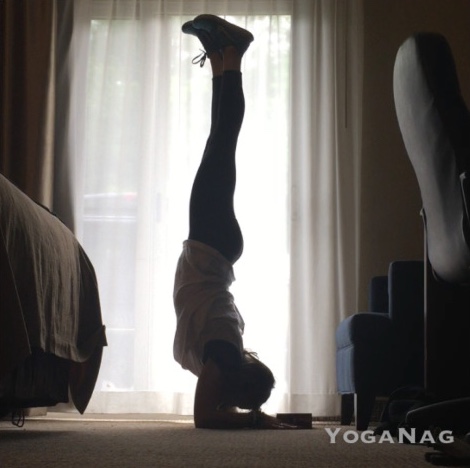
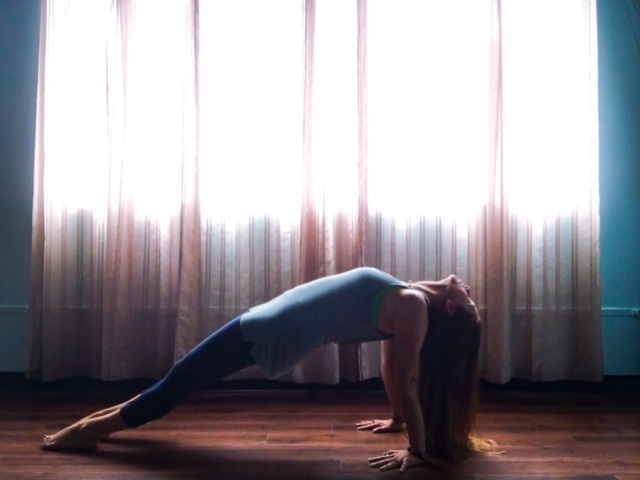
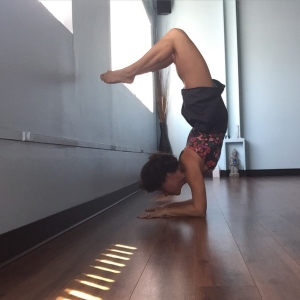
Flex your feet whenever they are off the floor. Spread your toes and flex them. Press through the four corners as if they were on the earth. As I mentioned, it activates the muscles in your legs, which protects them from tearing, as well as their attachment points, tendons and ligaments. In poses where only your heels are on the earth, such as Janu Sirsanana (Head to Knee pose) also flex them, keeping your toes pointing to the sky. Remember, relentlessly parallel. Your teacher may have particular tips, such as pressing through the mound of your big toe, in particular poses. He or she may also suggest a “flointed” foot in some poses, which is in between pointed and flexed. I prefer to call it “Barbie foot,” because that is funny, and yoga classes usually need a little sense of humor here and there. This foot action is fine. Again, rarely will you be asked to be a ballerina. No pointed toes unless a teacher that you trust, that doesn’t seem like a misplaced dancer, suggests it. The key is to keep your feet alive and active, with your muscles engaged, even when they aren’t supporting you.
When you lift your leg behind you in various poses, such as Chakravakasana, variation (opposite arm and leg lifted in table pose), Eka Pada Adho Mukha Savasana (One Legged Dog), Urdhva Prasarita Eka Padasana (Standing Splits), Virabhadrasana III (Warrior III), in addition to flexing that lifted foot, try to bring the back foot parallel to the front foot, as if you were standing on it. Tadasana foot behind you. This one is less about the safety of the knee and spine, and more about the proper alignment of the pelvis in the pose. A common tendency in these poses is to open our lifted leg up, bringing the lifted foot parallel to the floor. In doing this, we can lift our legs higher, which can feel fun and stroke our egos, because we are so impressed with how high we can get our foot. Look at me go! I am awesome at this! And it is fine if you want to do this, but please know that it is not in the best alignment. Or do it, to get it out of your system, and then reign yourself back in.
To come into better alignment, I like to use my baby toe as navigator, and send it, like an imaginary plumb line into the earth, which will also turn and lift your inner thigh up toward the sky. You can use your inner thighs as navigator too, turning them in and lifting them upward, but somehow the baby toe as navigator works better for me. And square your hips. In one-legged dog, your teacher may say, bend the knee of your lifted leg and open it up. That is okay. Go for it (but root evenly through both of your hands, keep your shoulders square, paying particular attention to the shoulder opposite the lifted leg, don’t let it collapse, hollow that armpit. See, I am relentless.) If, however, you are in a flow and doing a simple Eka Pada Adho Mukha Savasana (one-legged dog), plumb line your baby toe into the earth, and square your hips. There are ways to get that back leg higher, even with such alignment, but those are tips for another day.

Our feet are very important in yoga. Begin giving relentless attention to them in your practice. Place them, lift them, use them, rely on them, with care and intention. It will build each pose, from the foundation up, and will likely change your practice. Sometimes dramatically. It will help you with balance. It will build new muscles in your feet, and your legs, in your body. It can rebuild fallen arches and counter life’s hard knocks on these critical parts, it can help your lower back. It offers a lot more affection for you than a pedicure. It can do wonders for you all the way up to the crown of your head. I pinky toe promise.
Practice these relentless tips for your feet in your practice, at home, at the yoga studio, in the gym, in the park, wherever you are doing your yoga, and whether you have a teacher guiding you or not. Because, let’s be clear, even when you are taking a yoga class, you never know who your teacher is going to be. You may go to your awesome, regular class and be confronted with a substitute teacher. Someone like me, who won’t stop nattering at you about your feet. You may walk into a new gym or a new class, and not know if the teacher will watch you as you move through your practice. I am not trying to give yoga teachers a bad rap. I am one. I am merely trying to help all yogis out there have some agency in their practice, learn some simple ways you can protect yourself and grow your practice with integrity and awareness, on your own. Knowing more about your foundation is a simple way to give yourself smart and sweet care on your mat.
Become your own advocate, your own Agent for Relentless Alignment, your own ARA, on your mat. This is providing yourself with relentless affection. This is caring for yourself, with steadfast devotion. This is also safe, healthy yoga. As with all things yoga, it may inform your life off the mat as well.
Next week: ARA for your hands.

About our guest blogger: Daisy Whitemore is a mom, wife, writer, yogi, yoga teacher (substitute teaching at extendYoga sometimes), a recent blogger, and on a quest for life’s pauses, for the sweet spots–those moments, oftentimes slippery little cracks in the foundation of our daily lives–that give us pause, that don’t take our breath away, but give us breath. Just like those fleeting seconds at the top or bottom of your breath, between inhale and exhale, the pauses are always there–waiting for us to inhabit, explore, and experience. She hopes to encourage herself and those around her to find a little more pause in each day for silence, yoga, creativity, love, play, pleasure, or whatever it is that restores you. You can find her at www.findingpause.com and/or like Finding Pause (www.facebook.com/FindingPause) on Facebook.